
Mastering the Art of Being A Stud Running Back: Key Coaching Points for Running Backs

Hey football coaches and running backs! This is for you!
If you've ever watched a game or film where a RB explodes through the line for a big gain, you know it's not just about speed or power—it's about technique, vision, patience, smart decision-making and then getting downhill. Its also about those big boys up front making holes! Running the ball effectively is a cornerstone of any strong offense, and it's often the little details and coaching points that separate the good from the great.
In this post, we're diving into some essential coaching points that can transform how your running backs approach the ground game: the aiming point, pass blocking, footwork, vision, setting up the hole, and hitting the hole with purpose. All the ingredients for your RB's to succeed.
I'll break each area down with coaching points to help you implement them in practice and in your game planning. Whether you're coaching youth leagues, high school stars, or college RB's, these fundamental coaching points will build confidence in both you as a RB coach and your RB's.
No False Steps
No running back should EVER develop the habit of a false step. This wastes time, disrupts the QB and offensive rhythm, and is a very bad habit that needs to be broken. But Coach, what about draws, counters, etc.? That is different and actually requires footwork to work, not a false step. So what is a false step? Its when the RB steps backwards to go forwards. Terrible habit and one I hate to see RB's do. As if that were not bad enough, WR's do this as well. MUST BE Coached up to never do this!! Coaches work with your RB's to erradicate this. Players, work on never doing this. On offense...we always go forward towards the end zone. NOT backwards!
Establishing a Clear Aiming Point
Every successful running play starts with a clear and targeted aiming point. Think of it as a specific spot on the field where they're initially trying to drive the ball. This isn't some vague "run towards the end zone" directive; it's precise, like aiming for the inside shoulder of the guard on an inside zone play or the outside hip of the tackle on a power run.Why is this so crucial? The aiming point must align perfectly with the offensive line's blocking scheme. If the O-line is creating a crease at the B-gap (between the guard and tackle), your RB needs to be locked in on that exact spot.
Mismatches here lead to absolute chaos: the RB hesitates, the hole closes, and suddenly you're looking at a TFL. Without knowing where to run, the RB can't read the defense's reactions or see the secondary cuts that turn a 3-yard gain into a touchdown.
Coaching Points:
Drill It In: Use cones, garbage bins, or bags to mark aiming points during walkthroughs. Have RBs verbalize the point before each rep—"Aiming for the guard's inside shoulder!" This builds muscle memory and communication. Walk, ½ speed, execute.
Film Study: Review practice and game tape with your RB's. Pause on plays where the aiming point was hit perfectly versus when it was missed. Ask questions like, "What did you see here? How did the line's block match your path? Why did you chose the hole your did? Did you take a false step?"
Adapt for Levels: For younger players, simplify with numbers on the line (e.g., "Run to 1,3,5,7 - 2,4,6,8" ). As they advance, incorporate reads against the most common fronts youth and HS will see, like a 4-3, 4-4, 5-2, etc. Most youth programs today are fairly advanced. Especially at the 7th and 8th grade levels. If they are in 8th grade, better start prepping them for HS.
Common Pitfalls to Avoid: Don't let RBs freelance early. Emphasize that deviating from the aiming point disrupts the entire play design. Share stories from pros like Derrick Henry, who credits his success to disciplined aiming points that set up his devastating stiff arms.
Feet!: Teach your backs to NEVER stop running/moving their feet. Many a play has been successful because the RB didn't stop running or driving their feet. That extra yard your RB got because they didn't stop their feet could be the difference in the game, down, etc. Never stop running until the whistle or you are on the ground.
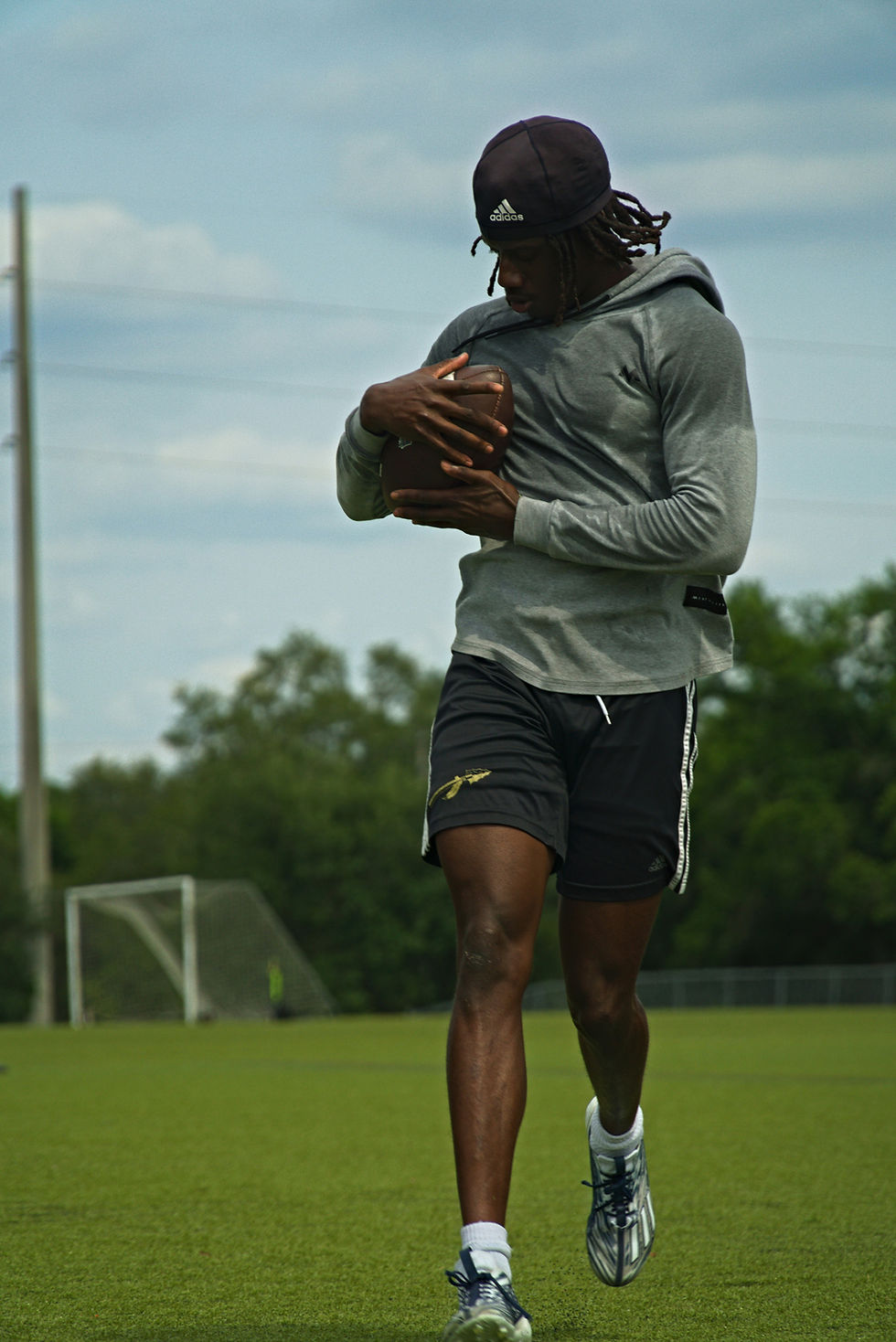
Protect The Football!: Always cover the points. What good is a great run if you fumble?
Head Up!: Many football players keep their head down when doing agility drills, RB drills, etc. Coach your players up to keep their eyes up and develop field vision. You can't see where you going if your always looking down and you most certainly cant see the LB's and DB's coming for you. Plus, you should be looking up and towards the end zone. Thats where you want to be!
By nailing the aiming point, your RBs gain vision—they'll start seeing not just the hole, but the defenders' leverage and potential cutback lanes. Vision is key and differentiates great RB's from good.
The Art of Setting Up the Hole
Once your RB has their aiming point dialed in, the next step is setting up the hole. This is where deception comes into play, turning a straightforward run into a mind game with the defense.
Essentially, you're faking one direction to draw defenders away, then cutting back to exploit the space you've created. For example, on an off-tackle play like a counter or trap, instruct your RB to press the edge hard for the first few steps—make it look like your bouncing outside. This "setup" pulls linebackers and safeties wide, widening the inside crease. After 2-3 steps, plant and cut sharply back toward the aiming point. Show the defense the outside threat, then hit them where they're vulnerable inside. Deadly.
This technique isn't just for big plays; it's about consistency. Don't be complacent. Make the defense defend. Good RB's do this! Defenses key on tendencies, so varying your setups keeps them guessing and prevents them from stacking the box.
Coaching Points:
Footwork Drills: Incorporate ladder drills or cone weaves to teach quick, explosive cuts. Focus on "pressing the line" with burst—short, powerful steps to sell the fake.
Defensive Reads: Teach RBs to watch the linebacker's flow. If the LB scrapes outside during your setup, that's your cue to cut back. Use scout team drills to simulate over-pursuing defenses. I am a big believer that all the offensive skill players should be making pre-snap reads just like the QB and OL.
Incorporate Variation: For inside runs, set up by dipping a shoulder as if going wide, then bursting straight. On outside zones, do the opposite: feint inside to pull the edge defender in, then bounce out.
Motivational Angle: Remind young RBs that legends like Emmitt Smith mastered this through patience and setup. Show clips of how a well-executed fake turned a potential stuff into a 20-yard gain. Coach them to emulate the NFL greats and break down what they do so your players understand the fundamentals and "Y"'s.
Mastering the setup: Turn your RB into a chess player on the field, manipulating gaps, varying speed and direction, and creating opportunities that weren't there initially.
Patience: Sometimes being patient waiting for the hole to open, or play to develop can be explosive. This is an art and science. If players can master this... control their explosiveness and field vision, you will develop outstanding next level RB's.
Committing to Hitting the Hole
Now comes the payoff: hitting the hole. Too many young RBs fall into the trap of bouncing everything outside (doesn't work so well at the HS, College or Pro Level...everyone is fast!) chasing the sideline glory instead of trusting the play design. But the truth is, the biggest plays often explode from inside runs—hitting that A or B-gap hard, then breaking tackles, bouncing, or cutting outside once you've gained momentum.The key mantra? "north-south first." Down hill! How many times have you heard that or said it! There is a reason!
Explode vertically...down hill, through the hole with low pads, powerful leg drive, and eyes up to read second-level defenders and find the end zone. Only after committing inside should you look for the cutback or bounce.
This approach not only maximizes yards but also wears down the defense over time. Breaking bad habits is tough, especially with speedy backs who love the edge. But if you are going to bounce to the edge you better be fast as grease lightning, otherwise you will end up in a violent collision with an OLB or Safety. But patience pays off: inside hits set up play-action passes and keep defenses honest. This is key. There is more to the run game than just running the ball. Setting up other big gain opportunities is a big part of it and the right RB makes that happen.
Coaching Points:
Bag Drills for Explosive Runs: Line up bags, garbage barrels, cones, etc. to simulate the hole, and have RBs burst through at full speed. Add a "decision point" cone where they choose to cut based on a coach's signal. Better yet, have a LB or RB 2 play LB to force a decision.
Tackle-Breaking Techniques: Teach the "dip and rip" or stiff arm while hitting the hole. Pair this with strength training like squats to build that lower-body power. If your program has a blaster, start blasting! A great under utilized tool these days.
Game-Like Scenarios: In 7-on-7 or 11-on-11, reward inside commitment with points or praise. Track stats: "How many times did we hit the designed hole versus bouncing?"
Psychological Edge: Build mental toughness by discussing and breaking down top beast NFL RB's, who thrive on inside punishment. Use positive reinforcement—celebrate those gritty 4-yard gains that set up the explosive ones. Remember, you only need a few short runs for a 1st down! Reinforce toughness. Your RB's should punish defenders either with shear power running or shifty mid/outside zone runs.
Protect The Football!: Incorporate blaster, rip, punch, pull drills with your RB's. THEY MUST COVER THE POINTS! NO FUMBLES! Reinforce ball handling drills. Changing arms, through the hole, running, etc. Proper form is key to ensuring your reduction in fumbles from your RB's. This is rule #1. DO NOT TURN THE BALL OVER!
Pass Protection: If you require your RB's to pass protect, coach them up on it! Don't just say, block this guy or who ever is free. Thats useless. Coach the RB on who in the play design they need to pick up. Coach them on leverage, hand position, footwork, etc. Many times, they may be trying to block a stud DE or a Safety on blitz from 10 yards away. Each defensive player requires a different technique to block. Coach your RB's up on this technique so your QB can execute the play.
Fakes: I always wanted my RB's to earn an Oscar for the way they faked getting the hand off OR how they executed draw plays. RB's must be consistent. There should be NO difference between them getting the ball or not. The defense must buy into the fake otherwise the play doesn't execute. This includes fake pass blocking before slipping out. NO half assed attempts. 100%, 100% of the time. The RB MUST sell the fake or get off the field. You are not contributing and potentially getting other players blown up.
Pass Routes: RB's never get enough coaching on running routes, proper hand position for catching AND running, chip blocking, etc. Coach your players up and invest the time to coach them on route running, breaks, bubbles, options, swings, wheels, etc. This is a skill set that must be repped. No use running bubbles and swings if your RB isnt able to catch the ball properly and get down field. No use having your RB chip block if they do it half assed and the defense doesn't buy it, etc. Coach them up on proper route running. It will pay dividends!
By incorporating these coaching points, your RBs will not only gain more yards, protect the ball better and reduce injury risk through proper pad level play, they will be able to contribute more and make your offense dynamic versus static. The more a defense has to do to defend against you, the better! That opens up opportunities. Remember, great RBs aren't born; they're coached. And coached well and often.
Coaches, need help or players want to work with us, reach out! We would love to work with you!
-Coach David Frederick

Comments